
Why customers aren't choosing your business, even when your products or services are good

In this article
The launch day nobody posts about
Picture a founder the night before launch. The product is ready and the packaging is done. The Instagram grid looks clean, the website is live and the WhatsApp number is on everything.
In their head, tomorrow is simple. People will see it, love it and pay.
There is a Reel that captures this perfectly. You can watch it here. A founder is sure customers will pay the moment the product launches. Then a real customer shows up, looks at the product, seems interested, and walks away without buying.
It is funny because most of us have been that founder. Nobody in that Reel is the villain.
Neither of them is wrong. They are just standing in different places.
The founder knows the months that went into the product. They know why the packaging looks that way, what each feature does and why the price makes sense. They need the launch to work.
The customer knows none of that. They see only what the business has put in front of them. A feature that excites the founder may mean nothing to them. They have no attachment to anyone's effort. They are simply asking three questions: Is this for me? Can I trust it? Is it worth my money?
If any of those answers is unclear, walking away is the easiest move. It costs the customer nothing.
Launching does not create demand, and having something good does not guarantee that anyone will find it, understand it or pick it. That gap is where many good businesses stay stuck, and it is what this article is about.
One warning before we go on. Not every business with a customer problem has a marketing problem. Sometimes it is the offer, the price or the market. We will get to how you tell the difference.
Good work does not announce itself
Doing good work and attracting customers are two separate jobs. Most founders do the first one very well and assume the second will sort itself out.
It rarely does. You probably know an excellent business that only a handful of people talk about, while an average one down the road is fully booked. The busy one is not always better, just better known and better understood.
A few things get mixed up along the way. Creating value and communicating it are different jobs, and nobody outside your customer list can see your standards. Happy customers do not automatically bring new ones, because someone has to hear about them. And a week full of posting, flyers and promos can still miss the people who would actually buy.
Every customer walks a path before they pay you. It looks like this:
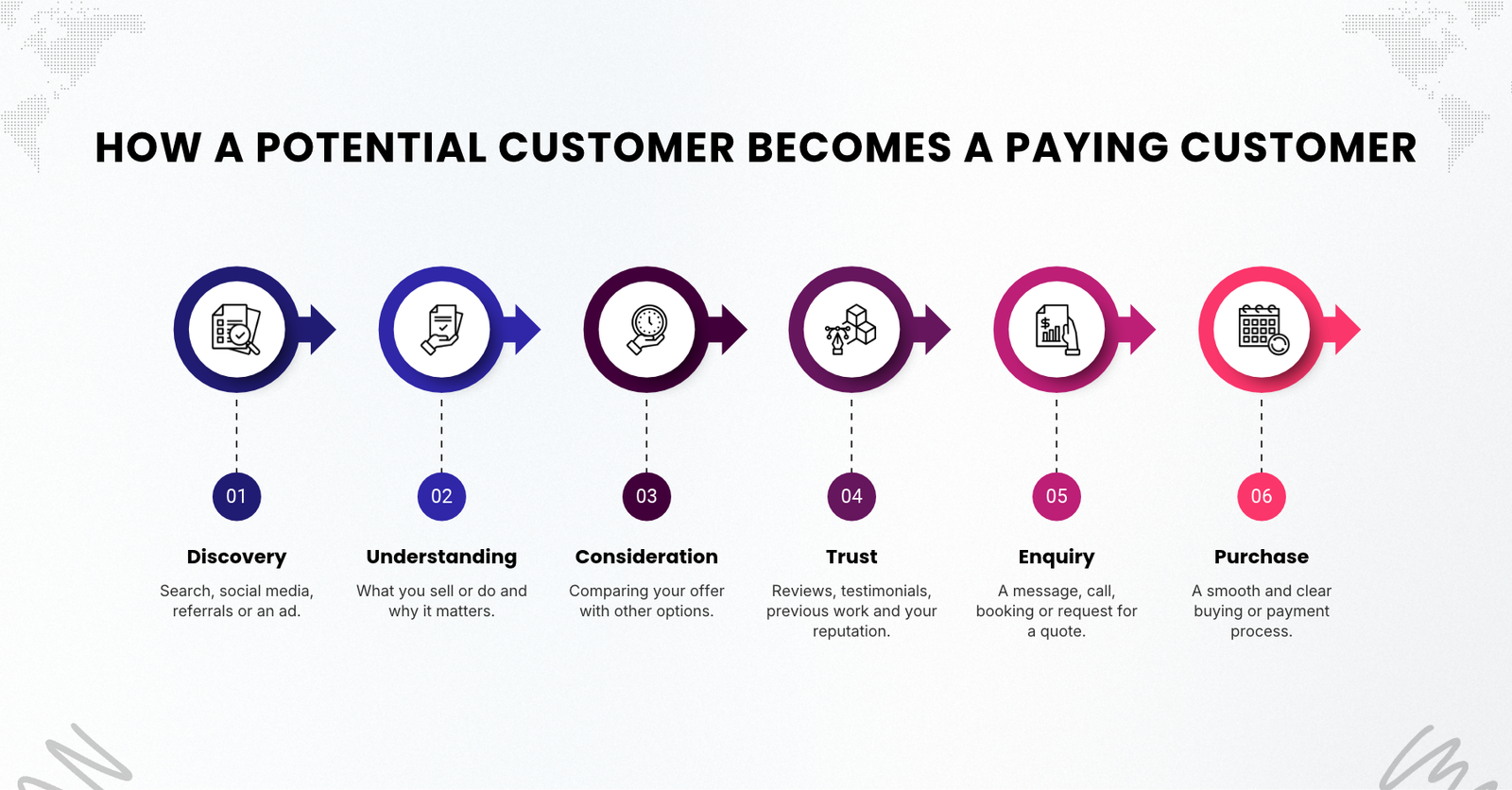
You can lose them at any step. Some people find you but cannot tell what you sell. Others understand the offer but see no proof you can deliver. And a few are ready to buy until your enquiry process turns into a maze.
Each step breaks for a different reason, so each needs a different fix. Let us walk the path and see where people fall off.
Eight places customers slip away
1. They never find you
Start at the beginning. A Facebook page, an Instagram account and a WhatsApp Business profile do not mean the right people can find you. They mean you have accounts.
Imagine a baker in Abuja whose cakes are genuinely the best on her street. If most of her orders still come from friends and friends of friends, she has a good product and a small door. Or imagine an architecture firm that does beautiful work, while the developers who need it have never heard the name.
Visibility comes from many places, and most businesses use one or two:
Search engines, for people who already know what they need
Social media, for people who are not looking yet
Referrals and recommendations
Partnerships with businesses that serve the same customers
Paid advertising
Directories and marketplaces
Local and industry communities, including WhatsApp groups, associations and events
Say you fix that, and people finally land on your page or walk into your shop. The next problem is waiting.
2. They find you but cannot tell what you sell
Potential customers should never have to guess.
Product businesses do this when descriptions list specifications and never say what the product does for the buyer. Service businesses do it with lines like “we provide holistic, end-to-end solutions”, which tell the client nothing about what they will receive.
Try this. Show your homepage to a stranger for a few seconds. Ask what you sell, who it is for and what they would do next. If they hesitate, so do your customers.
We wrote about the root of this in Your Business Knows Too Much About Itself. The more you know about your own work, the harder it gets to explain it to someone who knows nothing.
Now suppose the message is clear and people understand you. They also understand your competitors, who sound exactly like you.
3. They see no reason to pick you over the next business
Plenty of good businesses look identical to their competitors. The photos look alike, and so do the promises about quality and customer satisfaction. When everything looks the same, customers choose on price, convenience or whoever they saw last.
A reason to choose you can be small and honest. It could be faster delivery in a particular area or a focus on one kind of client. Take a tailor who promises every customer a fitting before the final stitching. That promise gives people a clear reason to pick that tailor over the next one. Say it plainly and back it with evidence. Skip claims like “the best in Nigeria”. Everyone makes them, so nobody believes them.
Copying competitors makes this worse. If you look like everyone else, you are asking the customer to find the difference for you, and most will not bother.
Even when you stand out, there is one more wall. Standing out gets you looked at, but it does not get you believed.
4. They do not trust you yet
A stranger knows only what you have shown them. Your track record is invisible unless you make it visible.
Proof can take many forms:
Reviews and testimonials
Case studies and examples of previous work
Before-and-after examples, where they make sense
Product demonstrations
A professional website that works
Consistent communication across your channels
Evidence of experience and expertise
Clear business information and contact details
There is research behind this. The Stanford Web Credibility Project built ten guidelines for trustworthy websites from three years of research involving more than 4,500 people. Several are plain common sense: make information easy to verify, show that a real organisation is behind the site, show your expertise, make contact easy and avoid errors. The same work found that people judge a site quickly by its visual design. The guidelines date from 2002, so treat them as a foundation and not a picture of online behaviour today.
A business can deliver excellent work and still look unproven, and proof is what closes that gap. I will show you how in a moment, using our own profiles.
Trust is not the only thing a buyer weighs. Money matters too.
5. They cannot tell what they are paying for
Think about the last time you asked for a price and got “it depends”, or received a quote with one big number and no breakdown. You probably did not argue. You just started looking elsewhere.
There is a difference between price and perceived value. An offer can feel expensive when the buyer cannot see what the money buys. The price may be fair while the explanation is missing. We went deeper on this in Why Clients Think You're Expensive Before Seeing Your Price.
And sometimes the price and the explanation are both fine, and the problem is who is looking.
6. You are talking to the wrong crowd
Attention is not demand. A post can pull thousands of views and not one order if the people watching cannot afford you, do not need you or live where you cannot deliver.
Ask yourself:
Do these people actually need what I sell?
Are they somewhere I can serve?
Can they afford it at my price?
Are they buyers, or are they just enjoying the content?
A business can get plenty of attention and still struggle to make sales. When that happens, check the audience before you blame the content.
Now assume you have the right people, and they are ready. There is still a way to lose them.
7. Buying from you is hard work
Some customers are ready and still do not buy. The process gets in their way.
Product businesses lose people at checkout, unclear shipping information, doubts about delivery time and vague return policies. Service businesses lose them with long enquiry forms, unclear booking steps, slow replies and quotations that take days to arrive.
A message left unanswered overnight can cost you a customer who was ready to pay. Poor follow-up does the same. Interest cools fast, and another business is one tap away.
8. You depend on referrals
Referrals are wonderful. Someone who arrives through a recommendation comes with trust already built.
But you cannot schedule a referral. A business that lives on word of mouth alone has no steady way for new people to find, remember and assess it. When recommendations slow down, there is nothing behind them.
Treat referrals as one source among several, supported by a deliberate way of being found and considered.
That is the full list. Before we talk about fixing any of it, let me tell you where I learned to see it.
I have watched this happen
I have worked in social media management and digital marketing for over eight years, and I have taught more than 300 students. One pattern keeps showing up: businesses mistake content activity for marketing progress.
They post often, their pages stay lively and a lot of effort goes into content, yet few stop to ask whether any of it helps a stranger understand why they should choose that business. Publishing content and using communication to support a business goal are different things.
Biografrica, an African media platform I worked with, showed me the other side. It grew from a very small online presence to nearly 70,000 followers across Instagram, Facebook, Threads and other platforms. The work covered social strategy, storytelling, video, community management and editorial content. The stories were always worth reading. What changed was how they were packaged and distributed, so people could find them.
To be clear, that growth shows reach and attention. It does not prove sales or revenue, and I am not claiming it does. Reach is one part of the path, not the whole path.
This is why Fastora exists. We kept meeting businesses with good products, capable teams, real customers and interesting stories that were hard to find or understand, usually behind a generic website and social pages that only shouted promotions. Our principle is simple: we think before we create.
Which brings me to the proof problem, and something small we changed on our own profiles.
Show your receipts
Recently, we pinned posts showing Fastora's results and testimonials on our Instagram and TikTok profiles.
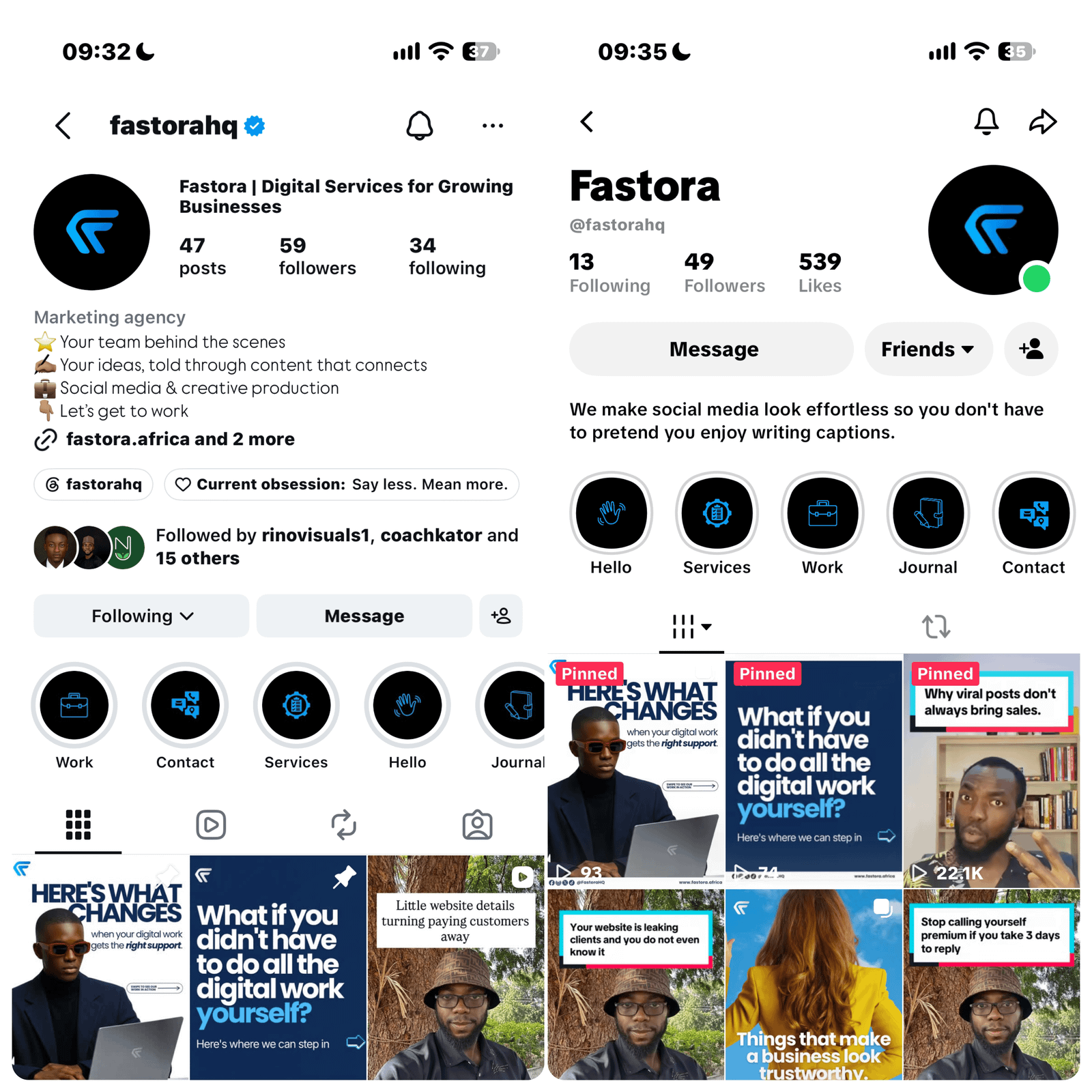
The thinking was simple. Someone finds Fastora for the first time. They like what we do, but they wonder whether we can deliver. Without pinned posts, they would scroll through the whole profile hunting for evidence, and most will not. Pinning puts our previous work, results and customer feedback where they land first.
The lesson for you: do not assume people who find your business already know what you have achieved. Make useful evidence easy to find.
Here are ways to do that:
Pin important testimonials and customer feedback.
Show examples of completed work.
Publish case studies that explain the problem, the work done and the outcome.
Share genuine results with enough context for people to understand what they measure.
Ask satisfied customers for permission to share their experiences.
For product businesses, use genuine customer photos, demonstrations and product reviews where you have them.
It also helps to know the three kinds of proof, because they do different jobs:
Type of proof | What it is | What it does best |
|---|---|---|
Testimonial | A short statement from a customer about their experience | Gives quick reassurance and a human voice |
Review | A customer's independent rating or comment, often on a third-party platform | Shows the feedback was not written by you |
Case study | A structured account of a problem, the work done and the result | Helps buyers with bigger decisions see how you work |
None of them guarantees trust or sales, but they reduce doubt, especially when they are specific, honest and easy to find.
Proof is one fix. To choose the right fix, you first need to know where people are leaving.
Find the leak before you refill the tank
Spending more on adverts or content before you know where customers drop off is like refilling a tank that has a hole in it. It feels productive, but the water still runs out. The Igbo have a proverb that fits: a man who cannot tell where the rain began to beat him cannot say where he dried his body. In business, if you cannot say where customers start slipping away, you will not know what to fix.
Here are the clues to look for, though they are clues and not verdicts.
What is happening? | What should the business investigate? |
|---|---|
People don't discover the business | Visibility and reach |
People see the business but don't enquire or buy | Messaging, relevance and positioning |
People enquire but don't proceed | Trust, pricing and the offer |
People receive quotations but don't buy | Perceived value, objections and follow-up |
Customers buy but don't return | Product or service quality and customer experience |
The path looks different depending on what you sell.
Product businesses usually lose people at presentation, pricing, checkout, delivery information and returns. Watch where shoppers leave your website or abandon a chat.
Service businesses usually lose people at understanding, trust and the enquiry stage. Count how many enquiries become conversations, how many conversations become quotations and how many quotations become clients.
Get evidence before you change anything. Find out why recent enquirers did not go ahead, which questions people ask before buying and where each enquiry came from.
One caution on research. Nielsen Norman Group describes the five-second test, where people look at a design for a few seconds and say what they make of it. It tests first impressions of a design. It does not mean customers decide whether to buy in five seconds, and I would not read it that way. The point that does hold is that you and your team are not your customers, so test what they actually see.
Once you know where the leak is, the fixing can begin.
What to do about it
Telling a business to post consistently is useless advice here. Try these instead.
Know who is most likely to pay. Look at your best existing customers. What do they have in common? A caterer may find that most repeat orders come from offices, not weddings. That changes where the effort goes.
Explain the offer in everyday language. Swap “comprehensive brand solutions” for what the client gets: a logo, a colour palette and a brand guide in two weeks.
Give people a reason to choose you. Find one or two honest strengths and make them obvious. A tailor who guarantees a fitting before the final stitch has a clear one.
Make your work and customer experiences visible. Pin testimonials, publish case studies and show finished work.
Fix your website and digital presence. It should say what you do, who it is for, how to reach you and what to do next. Repair broken links and typos. The Stanford research flagged small errors as more damaging than most people expect.
Go where your buyers already are. If they search for you, work on search. If they discover brands through short video, start there. Do not scatter yourself across everything.
Make it easy to enquire, book or buy. Shorten forms. Reply fast. State delivery times and payment options clearly.
Track where enquiries and sales come from. Ask “how did you hear about us?” and write down the answer. Without it, you are guessing which channel works.
Collect objections. Keep a list of the questions and doubts people raise. Repeated ones usually belong on your website.
Improve the product or service where needed. If feedback keeps pointing at the same weakness, no amount of messaging will cover it.
Number ten matters more than most people admit, and it leads to the harder conversation.
When marketing is not the problem
This part matters for the honesty of this article. Sometimes the problem has nothing to do with communication or visibility.
A business may struggle to attract customers because:
The product or service does not solve a problem people see as important.
There is not enough demand in the chosen market.
The intended customers cannot afford the offer.
Competitors provide a stronger or more suitable option.
The product or service itself needs improvement.
The business has not set up a sustainable way to deliver.
The business model cannot support the price or customer expectations.
Good marketing cannot create demand where none exists or make an unsuitable product valuable. If your enquiries and customer conversations point here, fix the offer or the model before you spend another naira (or dollar - whatever your currency is) on promotion.
And if the evidence says the offer is sound but people are not seeing, understanding or trusting it, that is where communication work earns its place.
Where Fastora fits
When the leak is in how a business explains, presents and distributes its work, four kinds of work usually help:
Communications Strategy decides what to say, who needs to hear it and how to say it.
Brand Positioning helps people see what makes a business different and why they should choose it.
Content & Storytelling turns a business's work, knowledge and experience into stories people can understand.
Digital Marketing reaches the people a business wants to serve through suitable digital channels.
Which one comes first depends on the problem. A business nobody finds needs something different from one that people find but do not understand.
None of this fixes everything in this article. Pricing, operations, the product and the business model sit outside what communication can change.
Back to the founder
Go back to the Reel. The founder was not wrong to expect customers. They had done the hardest part, which was building something, and assumed the rest would follow.
A good product or service is the foundation. Customers still need to find you, understand what you offer, see its value and feel comfortable choosing you.
So before you spend more on adverts or produce more content, find out where people are dropping off. That answer can save you a lot of money.
Fastora is a communications and digital services company that helps growing businesses explain their value and handle the digital work needed to reach the right people. If you are not sure where your customers are slipping away, that is usually the best place to start.
Quick answers
Why aren't customers choosing my business?
Usually something breaks along the path. They have not found you, do not understand your offer, do not trust you yet, find your price unclear or struggle to buy. Sometimes the cause runs deeper, such as weak demand or an offer that does not fit the market.
Why does a business struggle to get customers even when it offers good products or services?
Quality and visibility are separate things. Customers can only choose what they can find, understand and trust. A good offer that is hard to explain can lose to an average one that is easy to understand.
How can I attract more customers to my business?
Start with who is most likely to buy. Explain your offer clearly, show proof of your work, use the channels your buyers use and make it easy to enquire or buy. Track where enquiries come from so you know what works.
Why do people visit my website but not make enquiries?
Common causes are an unclear message, weak proof, a confusing next step, hard-to-understand pricing, or visitors who were never likely to buy. Ask a few people to look at the site and tell you what you sell and what they would do next.
Can a good business fail because of poor marketing?
Yes. A good business can struggle if the right people never find it or understand its value. Marketing is not always the cause, though. If demand is weak or the offer does not suit the market, better marketing will not rescue it.
How important are reviews and testimonials when attracting customers?
They help new customers judge a business they have not used before. They work best when they are specific, genuine and easy to find. They support trust but do not guarantee sales.
How can I know whether my problem is marketing or my actual product or service?
Look at the pattern. If few people find you, look at visibility. If people find you but do not enquire, look at messaging and positioning. If customers buy and do not return, or complain about the same thing repeatedly, look at the product or service. Talk to customers and to people who chose not to buy.
Why do customers show interest but fail to buy?
Usually there are unanswered questions behind it: doubts about trust, price, delivery, fit or what happens after payment. Slow replies and a hard buying process also lose interested people. Ask them what stopped them.
Sources
Fogg, B.J. (2002). Stanford Guidelines for Web Credibility. Stanford Persuasive Technology Lab.
Chan, M. (13 December 2024). Testing Visual Design: A Comprehensive Guide. Nielsen Norman Group.
Enjoyed this article?
Receive the next one in your inbox.